
EXPLORE...
Chronology
Biographies
Context

Instruments > Mathematics
Geometric and military compass
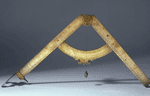
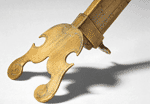
Inventor and maker: Galileo Galilei
c. 1606
Brass
Length 256 mm, width (open) 360 mm
IMSS, Current inventory: 2430
One of the
many compasses built by Galileo starting in 1597. Possibly the model presented
by Galileo to Cosimo II together with a copy of Le operazioni del compasso geometrico et militare [Operations of the geometric and military
compass] (Padua, 1606). The Galilean compass-not to be confused with
drawing compasses-is a sophisticated and versatile calculating instrument for
performing a wide variety of geometrical and arithmetical operations, making
use of the proportionality between the corresponding sides of two similar
triangles. It comprises three parts:
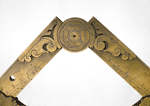
- the two
legs, held together by a round disk (pivot), whose faces (front and back) are
engraved with numerous scales;
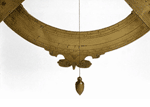
- the
quadrant, graduated with various scales, which is fixed by means of wing nuts
to the holes in the compass legs;
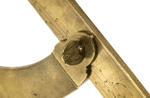
- the
clamp, a cursor inserted into one of the compass legs; keeps the instrument
vertical and can serve as an extension for the leg holding it.
The
priority for the instrument's invention was claimed by the Milanese Baldassarre
Capra in a work published in Padua in 1607. Galileo replied effectively to
Capra's claims with a peremptory Difesa
[Defense].
The
compass, initially kept in the Uffizi Gallery, was transferred in the
mid-nineteenth century to the Tribuna di Galileo.